Choosing the right Ppf Cutting Plotter can shape daily workflow, material savings, and customer satisfaction. A poor match may leave lifting edges, wasted film, and repeated installation work. This guide examines ten practical tips for making a safer, more informed choice.
The discussion draws on installer experience, manufacturer specifications, and common shop-floor requirements. It considers cutting accuracy, software compatibility, blade control, working width, feeding stability, noise, maintenance, training, warranty support, and total ownership cost. Look closely at real details. Can the machine follow a tight bumper curve without tearing the film? Does its software provide reliable pattern access and simple editing tools? A clean test cut on a sample panel often reveals more than a polished product photograph.
Not every expensive plotter suits every business. A compact studio may value quiet operation, while a busy workshop needs speed and dependable roll handling. Verify claims through manuals, service records, independent demonstrations, and feedback from experienced installers. Local support matters when a sensor fails during a Friday afternoon rush. It is easy to overlook.
Some recommendations may require adjustment because film brands, climates, workloads, and operator habits differ. Even experienced technicians can misjudge long-term costs or underestimate training time. Treat each tip as a decision checkpoint, not an absolute rule. Careful comparison, documented testing, and honest reflection can help buyers select equipment that performs consistently and supports professional paint protection film work.
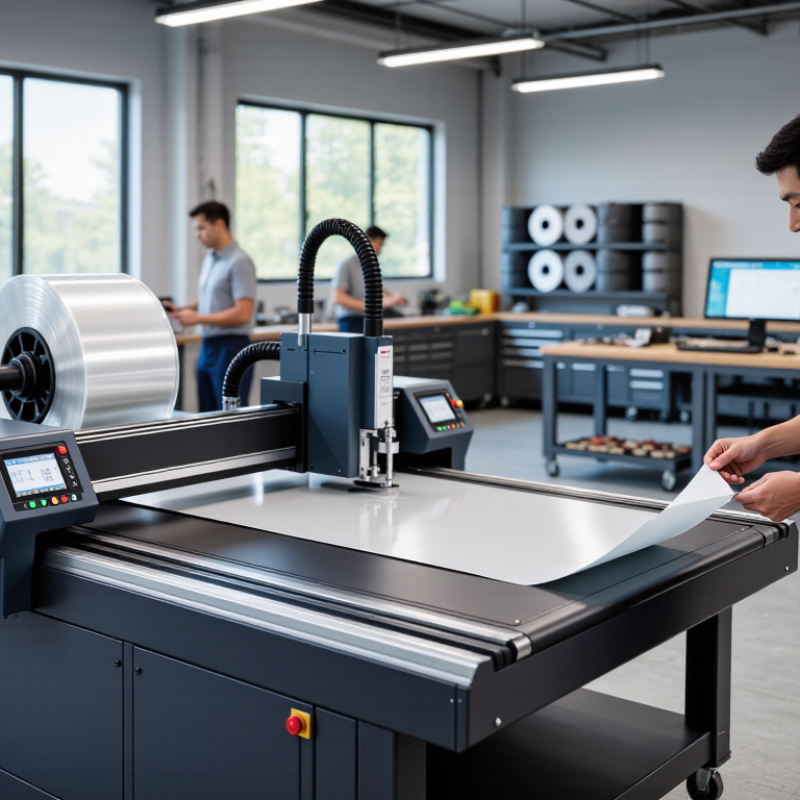
A PPF cutting plotter should match the film, not merely the vehicle template. Most automotive paint protection films measure about 0.15–0.20 mm, or 150–200 microns, including the protective top layer. ASTM D1005 and ISO 4593 describe recognized film-thickness measurement methods. Use those methods when checking supplier data.
Thicker film can improve impact resistance, but it may require slower cutting, higher blade pressure, and wider corner compensation. A 0.20 mm film may also lift differently around mirrors and tight bumpers.
Industry converting guidance from Smithers emphasizes process control, dimensional stability, and consistent web handling in protective-film production. Small errors become visible on curved panels.
Do not trust thickness alone. A 2024 technical review by Grand View Research links automotive film performance with substrate quality, surface treatment, and installation conditions, not just nominal gauge.
This part is often overlooked. I once assumed a thicker film needed more force; the edge quality proved otherwise. Plotter selection should follow measured film behavior, cutting trials, and repeatable workshop records.
Choosing a PPF cutting plotter starts with roll width, not software features. Most paint protection film rolls commonly measure 60 or 72 inches wide. Grand View Research estimates the global automotive films market was worth roughly USD 6 billion in 2023, reflecting wider demand for efficient installation systems. That growth makes material compatibility increasingly important.
Measure the roll, not just the catalog label. A 60-inch plotter should provide usable clearance beyond the film’s actual width. Otherwise, edge curling can affect alignment. For 72-inch rolls, choose a plotter with at least 74–76 inches of practical cutting space. This small margin helps when loading wet or slightly uneven material. It also reduces accidental contact with rollers.
Width affects waste. A plotter that barely accepts the roll may force repeated trimming, especially around large hoods and roof panels. Industry cutting-equipment surveys often link wider media handling with lower setup frequency and better shop throughput. Still, bigger is not automatically better. A wider machine may consume more floor space and require stronger support. I have seen operators overestimate available room. Measure doorways, tables, and service access first. The correct choice matches common 60–72 inch formats, daily vehicle volume, and the operator’s real working habits.
Cutting accuracy should be tested against the practical ±0.1 mm industry benchmark. Treat that figure carefully. It is not a universal legal standard. However, it is a useful purchasing threshold for paint protection film work, where a small edge error can expose paint or waste expensive material. ISO 230-2:2014 recommends evaluating machine positioning accuracy and repeatability under controlled conditions. Use the same method when comparing plotters.
Request a documented test using a calibrated optical measuring system, not a ruler. Ask the supplier to cut several 1,000 mm test lines, corners, circles, and narrow tabs. Measure both the first cut and repeated cuts. Small errors compound. Check results at approximately 20°C, following ISO 1:2016’s reference temperature for dimensional measurement. Film tension, blade wear, liner movement, and software scaling can also affect results. ASTM E2309 provides useful principles for verifying displacement-measuring systems.
I would not trust a single perfect sample. Repeat the test at different speeds and across the cutting bed. Record the maximum deviation, average deviation, and repeatability. A machine achieving ±0.1 mm once may fail after long continuous cutting. That matters. A transparent test report, calibration date, and clear measurement method reveal more than a bold accuracy claim.
When choosing a PPF cutting plotter, examine its software before judging speed or cutting width. Digital templates should match common vehicle shapes and panel variations. Look for searchable libraries, clear preview images, and accurate measurement tools. A good system lets you rotate, mirror, scale, and adjust patterns without complicated steps.
Test the software with a real sample file. Import a template, place it on the virtual film, and check every edge around mirrors, vents, and curved panels. The interface should show waste areas clearly. It should also allow small pattern edits directly on the workstation. That matters during installation. Real vehicles often differ slightly from library data.
Ask how often the template library receives updates. New vehicle versions may have different trim, sensors, or body lines. Reliable software should record revision dates and explain pattern changes. Cloud access can help, but offline access remains useful when internet service fails. Check file export options, measurement units, and compatibility with common design formats.
I once trusted a large pattern library without testing its search filters. Finding one rear-quarter template took too long. That experience changed my checklist. Software support must include practical training, responsive technical help, and readable instructions. Phone support is useful, but searchable guides and short repair videos can save more time. No library is perfect. Confirm whether users can report errors and receive corrected files. A trial period may reveal hidden limits before the plotter becomes part of daily work.
Use this practical 100-point checklist to compare how well a plotter’s software supports digital templates and pattern libraries. Verify each capability during a live demonstration before making a purchase.
Higher scores indicate greater importance when evaluating software for accurate, efficient, and repeatable PPF cutting workflows.
Choosing a PPF cutting plotter starts with controlled blade force, not the highest number on a specification sheet. Too much force can mark the liner, while too little force leaves rough edges and manual trimming. Experienced operators should test several film types, record settings, and check the first cut under bright light. Small trials prevent expensive waste.
Workflow speed depends on more than cutting rate. Measure setup time, pattern recognition, file transfer, roll loading, and rework. A slightly slower machine may finish more orders when registration is stable and software errors are rare. Track completed panels per hour for two weeks. That evidence is more useful than a brochure claim. I would also question my own time estimates; busy mornings expose hidden delays.
Safety belongs in the purchasing calculation. The WHO and ILO estimated 1.9 million work-related deaths globally in 2016, showing why routine hazards deserve serious attention. Look for guarding, clear emergency stops, low-noise operation, and simple maintenance access. The U.S. Bureau of Labor Statistics recorded about 2.6 million nonfatal workplace injuries in private industry during 2023. Training still matters. Include it in the budget.
Total ownership cost includes blades, mats, calibration, software, electricity, training, service, downtime, and discarded film. Compare these costs over three years, not only the purchase price. Ask for measurable service response times and expected consumable life. A cheap plotter can become costly when one failed job delays an entire vehicle bay.
| Tip | Key Selection Dimension | Practical Benchmark | Why It Matters | What to Verify Before Buying |
|---|---|---|---|---|
| 1 | Match the cutting width to your vehicle mix | Common usable widths are approximately 600 mm, 1,200 mm, and 1,600 mm. A 1,200 mm class machine suits most car panels; wider machines reduce the need to split large patterns. | The correct width reduces seams, material waste, and repositioning time on hoods, roofs, and large side panels. | Measure the widest film rolls and vehicle patterns used in your shop. Confirm the true cutting width, not only the machine’s outside width. |
| 2 | Compare blade force and pressure control | Typical plotters provide roughly 20–500 gf of blade force; heavier-duty systems may reach about 600–1,000 gf. For PPF, fine pressure adjustment and stable low-force cutting are more important than maximum force. | Controlled pressure helps cut the film cleanly while minimizing the risk of marking the liner or cutting through it. | Ask for pressure increments, repeatability, test-cut results, and whether the software stores separate settings for different film types. |
| 3 | Evaluate real workflow speed | Advertised maximum speeds may range from approximately 500 to 1,000 mm/s. In practice, complex PPF patterns often run slower because of corners, small features, acceleration, and weeding requirements. | Actual throughput depends on cut time, loading, registration, weeding, and operator handling—not the headline speed alone. | Request a timed demonstration using a full-size hood or bumper pattern and include setup, cutting, unloading, and file preparation time. |
| 4 | Check tracking accuracy on long cuts | Professional roll-fed systems commonly specify tracking accuracy in the region of ±0.1–0.3 mm under suitable operating conditions. Long jobs require reliable pinch rollers and media alignment. | Poor tracking can create shifted edges, mismatched sections, and wasted film on long vehicle patterns. | Test a 2–3 m longitudinal cut and confirm the stated accuracy, recommended media thickness, roller adjustment, and calibration procedure. |
| 5 | Prioritize PPF software and pattern workflow | Useful functions include automatic nesting, mirroring, scaling, pattern offsets, panel separation, material estimation, job history, and support for common vector formats such as DXF, SVG, or PLT. | Efficient software can save more labor than a modest increase in cutting speed. | Confirm subscription terms, pattern-library access, offline operation, export options, update policy, and compatibility with your existing design workflow. |
| 6 | Review safety and operator protection | Prefer enclosed or guarded moving areas, emergency-stop controls, pinch-point warnings, stable media stands, and automatic pause or fault detection where available. | Good safety design lowers the risk of injury, media damage, and unplanned machine stoppages. | Inspect the emergency stop, accessible controls, power protection, noise level, maintenance access, and conformity documentation for your region. |
| 7 | Check media handling and liner compatibility | A suitable PPF plotter should handle common film-and-liner combinations without slipping, curling, adhesive buildup, or excessive static. Roll holders and take-up systems improve consistency on long jobs. | Stable media handling improves cut quality and reduces reloading, wrinkles, and wasted material. | Run your actual film thickness and liner through the machine. Check maximum roll diameter, core size, media weight, and available take-up options. |
| 8 | Measure setup, calibration, and training time | Routine loading and calibration should be simple enough for a trained operator to complete in about 5–15 minutes. More advanced systems may require additional setup but can support repeatable presets. | Shorter setup time increases daily capacity and makes consistent results easier for multiple operators. | Ask for a live changeover demonstration, written operating procedures, training duration, and access to troubleshooting documentation. |
| 9 | Calculate maintenance and consumable costs | Budget for blades, blade holders, cutting strips, pinch-roller wear, cleaning supplies, software fees, electricity, and occasional calibration. Blade replacement intervals vary widely with film type, pressure, and usage. | Low purchase price can be offset by frequent consumable replacement, downtime, or expensive software obligations. | Obtain a 3-year consumables list, replacement prices, preventive-maintenance schedule, warranty coverage, and expected service response time. |
| 10 | Compare total ownership cost, not only purchase price | A practical 3-year budget should include equipment, software, installation, training, consumables, maintenance, electricity, downtime, and financing. For many professional installations, these added costs can represent 20–50% of the initial equipment price over three years. | The lowest initial quote is not always the lowest-cost solution when labor savings, reliability, and support are included. | Use the same workload assumptions for every option: rolls per month, average cut length, operator wage, waste rate, downtime, service fees, and resale value. |
Note: Performance ranges are typical industry planning values rather than guarantees. Actual results vary with blade type, film construction, liner stiffness, pattern complexity, media handling, operator skill, and machine calibration.